Introduction
The pictures on this web page are made with my 14-inch Celestron telescope and SBIG CCD camera, located at my Hereford, AZ residence.
Each night that I get worthwile images I place them at the top of this web page (i.e., time goes up). Mars has a rotation period of 24 hours and 37 minutes, and since each night's observations occur at about the same time (near midnight) there is an apparent shift in the Martain central meridian longitude (CML) that averages -8.82 degrees.
All my images are with south up (a tradition started by visual observers), so during an evening the planet appears to rotate leftward, but on successive nights the Martian globe appears to shift rightward (for images taken at the same local time on Earth).
All my images are enhanced in order to render the subtle albedo features more apparent. I typically use such processing procedures as unsharp mask, digital development and high frequency filtering. Visual observers won't see the major features with the same contrast as in my images, but they will see all features as sharper. The appearance of sharpness for visual observers is caused by the eye/brain's ability to recall brief instances of sharpness (produced by an ever-changing atmosphere), while neglecting to hold in memory the fuzzy moments. My CCD exposures are 0.1 seconds and longer, and I have a limited number to chose from during an evening's observing, so it is unlikely that any of my exposures will capture the sharpest moments.
October 14
This image shows the "residual" South Polar Cap (SPC) which is said to consist of a mixture of water ice and (overlying) dry ice (frozen carbon-dioxide). Since water ice stays frozen longer as the SPC region warms (subliming at 200 K, instead of ~150 K for dry ice), the ressidual SPC never completley disappears. Also note that the much-fear global dust storm never materialized during this Martian southern hemisphere summer. The Martian disk had a diameter of 18.0 "arc (versus the maximum of 25.1 "arc reached last August 27). [2003.10.14, Celestron CGE-1400, SBIG CFW and ST-8XE CCD, IR filter; Hereford, AZ]
September 5
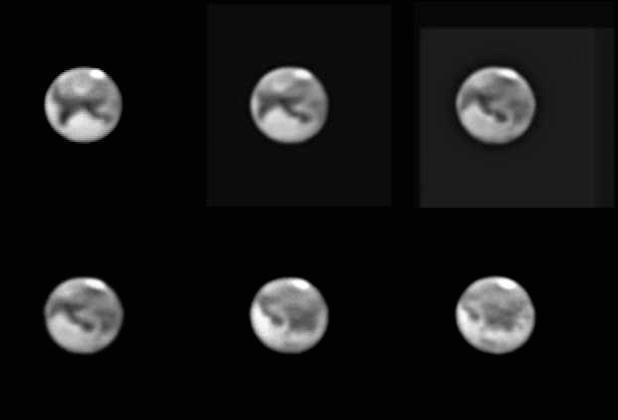
Figure Red filter images only were used to create this 8-frame animation of Mars rotating during a 5.2-hour period on September 5 UT. CML for the 8 images = 313, 330, 33, 345, 347, 351, 001 and 016 degrees. The planet's apparent diameter is 24.72 "arc. [Celestron CGE 1400, JMI focuser, SBIG CFW8, SBIG ST-8XE CCD; 2003.09.05 UT; Hereford, AZ]
During this observing session the atmosphere was not as stable as on previous sessions (FWHM = 2.9 "arc). The first image shows the most prominent and darkest feature, called Syrtis Major.
August 29
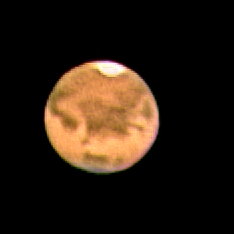
Figure Contrast-enhanced LRGB image of Mars taken August 29, 0445 UT, when the central meridian longitude was 30 degrees. The seeing was 2.3 "arc (FWHM). [Celestron CGE 1400, JMI focuser, SBIG CFW8, SBIG ST-8XE CCD, red filter exposure 0.1 seconds (8), green filter 0.15 seconds (8) and blue filter 0.4 seconds (10), "L" is a very enhanced version of the red filter image; seq #0405; Hereford, AZ]
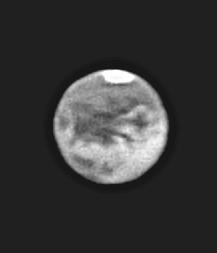
This is a single-frame red-filter image. With single frames you always get sharper images since you're not averaging frames with slightly different atmospheric distortions. The smallest discernible feature has a width of ~0.6"arc. This resolution is better than the FWHM derived from 4-second exposures of stars, due to the much shorter exposure time for Mars (0.1 second). CML = 55 degrees. [red filter, 2003.08.29, 06:30 UT]
For an example of what "aggressive processing" can do to improve the appearance of a raw image, go to the bottom of this page.
August 28
The night of August 27/28 had an opening in the clouds for a couple hours, which also afforded unusually good "atmospheric seeing" (stable and sharp views). This was one day after the historically best closest approach, and the Martian disk had an apparent diameter of 25.1 "arc.
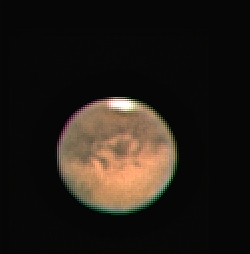
Figure This is a contrast-enhanced LRGB image of Mars taken August 28 UT, when the central meridian longitude was 85 degrees. The seeing was 2.0 "arc (FWHM). [Celestron CGE 1400, JMI focuser, SBIG CFW8, SBIG ST-8XE CCD, red filter exposure 0.1 seconds (3), green filter 0.15 seconds (3) and blue filter 0.4 seconds (4), "L" is a very enhanced version of the red filter image; Hereford, AZ]
The next image is an enlargement with names of common features.
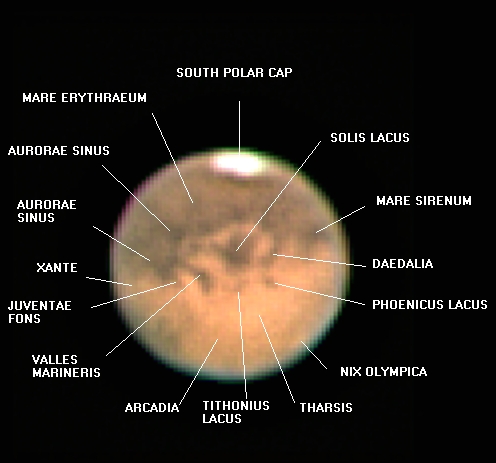
Figure 2. Names of bright and dark features using an enlargement of the previous image.
Solis Lacus is the most prominent feature (aside from the bright south polar cap). However, we now know that Valles Marineris is an immense canyon, as long as the US is wide and deeper than the Grand Canyon in Arizona.
August 3, 8 and 10
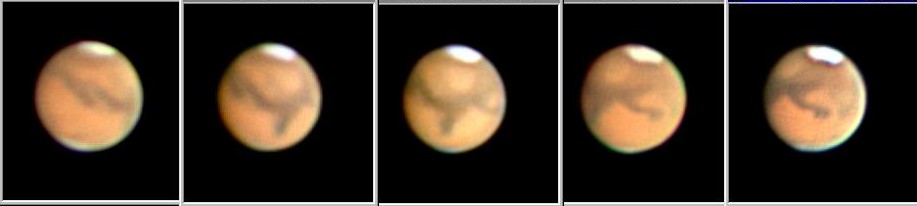
Figure 3. A selection of images of Mars during 3 dates in early August, with corresponding Central Meridian Longitude (CML) values 229, 266, 282, 340 and 355 degrees. Diameter = 22.7, 23.1 and 23.2 "arc (Aug 3, 8 and 10). [Celestron CGE 1400, JMI focuser, SBIG CFW-8, SBIG ST-8XE CCD; Hereford, AZ]
Mars was so bright in my new 14-inch telescope that I had to block ~10% of the aperture to prevent overexposure with the red filter (I couldn't shorten the exposure time below 1/10 second). Each image is a combination of RGB images with exposures times of 0.11, 0.11 and 0.35 seconds (2 or 3 exposures per color). Sharpening (Kernel filter) and "unsharp mask" enhancements were performed.
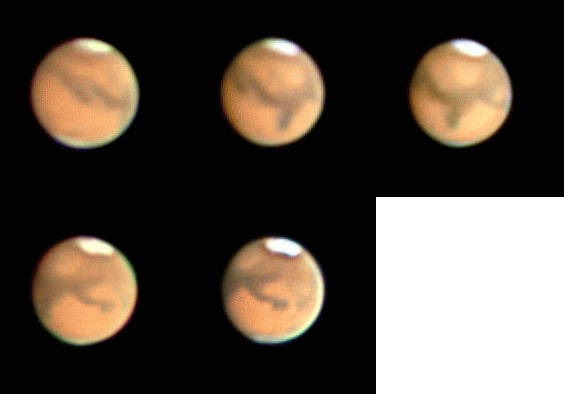
Figure 4. Rotation animation created from the above 5 frames.
So far, there is no evidence of a dust storm in its usual birth place in Hellas (south of Syrtis Major).
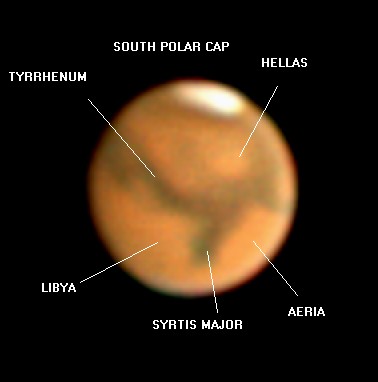
Figure 5. Names of Martian features that can be seen when Syrtis Major is near center.
Mars is just 3 weeks away from it's historically close opposition, and it's areal size is now ~82% of the August 27 maximum.
Example of Aggressive Processing
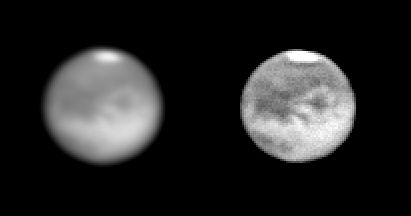
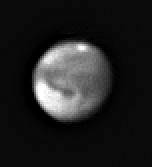
This pair of images demonstrate how much "information" can be recovered
by an appropriate sequence of image enhancement processing. The raw
image was chosen at random from a set of raw exposures with a red filter
and an exposure time of 0.1 seconds. The sequence of processing steps
in this example is: UMfe/Kg/Ds/UMfe/Kh/DDfm. These are my abbreviations
for Unsharp Mask FFT mild, Kernel filter high pass more, double size, Kernel
filter high pass medium, and Digital Development filter mild.
___________________ HUBBLE SPACE TELESCOPE _________________________________
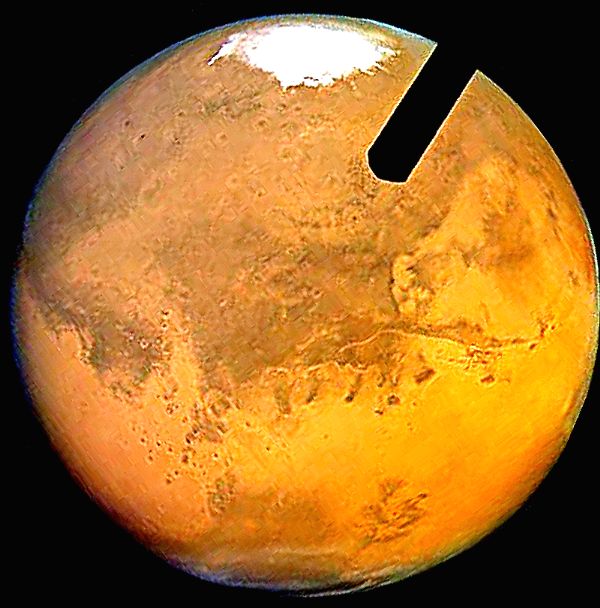
Wow! HST took this pic close to opposition. I've enhanced it quite severely, and in the process lost the polar cap structure. Not to worry, the polar cap is shown below.
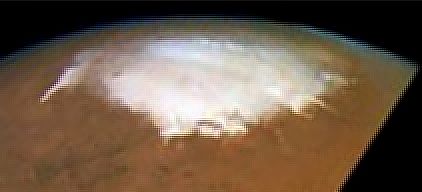
South polar cap (dry ice covering water ice). Slightly different
scale from above image.

Return to AstroPhotos
____________________________________________________________________
This site opened: August 3, 2003. Last Update: October 27, 2003