Bruce L. Gary (GBL), Hereford Arizona Observatory
(G95), 2005.06.26
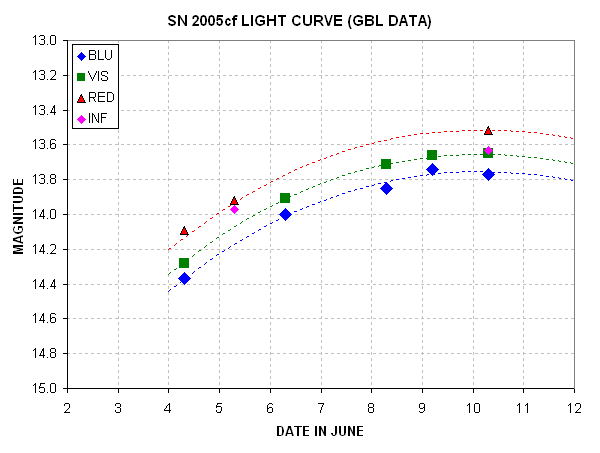
This web page is devoted to my observations of SN 2005cf. I will list BVRI magnitudes of the SN and maintain a light curve graph. A suggested photometric sequence is given at the bottom of this web page. Sorry, but other observer's measurement are not included on this web page.
Links Internal to This Web Page
Finding Chart and
Photometric Sequence
SN 2005cf, hereafter referred to as SN05cf, is a Type Ia supernova
located at RA =
15:21:32.21 -07:24:47.5 (equinox 2000.0). At the present time it
transits at about 10:30 pm (local standard time), so this is a good
season for observing this
SN. Maximum brightness occurred June 10. My interest in this
object is prompted by the observing challenges of monitoring an object
whose color varies, causing the light curves for each filter band to be
slightly different.
In case you think I'm "in love with my data" because I don't show
data from other observers, there are several reasons in explanation.
First, I had a bad experience playing with someone else's data last
year and I've sworn off the practice. Secondly, the observer who took
the data knows the strengths and shortcomings of it, and what
adjustments are permissible. When I worked professionally with data
before my retirement (in the atmospheric sciences) there were rigorous
rules about getting permission to do things with other people's data,
so I'm adhering to this cautious principle here. All of my data is
submitted to the WebObs before it's shown here. Thirdly, as long as I'm
on a "soap box," the AAVSO archive does not provide for an unambiguous
description of a measurement's precision and accuracy. Technically, a
datum is useless until these two error components are available. Ever
since I joined the AAVSO I've complained about their archive containing
just one number per observation, instead of three numbers. I'm not a
revernt person, but I have great reverence for measurements, and I
claim that a measurement is not a measurement until it has an
associated precision and accuracy. Since there's no unambiguous
provision for that in the archive I have been supplementing my AAVSO
submissions with web page descriptions of my observations. I'm hopeful
that two new data cells will eventually appear on WebObs some day.
Until that day I hope others, with an equal reverence for measurements,
will also create their web page descriptions. (Incidentally, I might in
fact be in love with my data, since I'll spend an hour worrying about
the last 0.01 magnitude correction.)
The following table shows BVRI magnitudes based on
ensemble photometry using either 5 or 6 of the brightest "Const"
reference stars listed in
the Photometric Sequence section, below. All reference stars, as well
as SN05cf, are treated with proper instrumental corrections for B-V
star color (using my Simplified
Magnitude Equations procedure, which is more accurate than the
AAVSO version of CCD Transformation Equations). The +-SE entries are
total SE
(orthogonal sum of stochastic SE and estimated systematic SE). In
almost every case the stochastic SE is <0.01 magnitude, so the total
SE is dominated by my estimated systematic uncertainty.
| Date |
BLU |
VIS |
RED |
INF |
Notes |
| June 04.3 |
14.37 +- 0.10 |
14.28 +- 0.04 |
14.09 +- 0.05 |
B-V = -0.06 +- 0.07 |
|
| June 05.3 |
13.92 +- 0.03 |
13.97 +- 0.06 |
|||
| June 06.3 |
14.00 +- 0.06 |
13.91 +- 0.04 |
B-V = +0.09 +- 0.08 | ||
| June 08.3 |
13.85 +- 0.04 |
13.71 +- 0.03 |
B-V = +0.14 +- 0.05 |
||
| June 09.2 |
13.74 +- 0.07 |
13.66 +- 0.04 |
B-V = +0.08 +- 0.08 | ||
| June 10.3 |
13.77 +- 0.05 |
13.65 +- 0.03 |
13.52 +- 0.04 |
13.63 +- 0.05 |
B-V = +0.12 +- 0.06 |
| June 27.2 |
14.11 +- 0.03 |
||||
Light curve using only GBL data. Fitted traces are a 3rd order
polynomial.
I hesitate to include other observer's brightness measurements in
the same graph for two reasons: 1) The SN is changing color, which
requires that a careful star color correction be applied to the SN
(using simultaneous 2-color measurements), which I'm not sure every
observer is doing, and 2) the reference stars ("comparison" stars) have
different colors so SN magnitudes will have different offsets for
different observers considering that each observer's systematic errors
are likely to be different due to either differences in the treatment
of reference star color (i.e., air mass neglect for some
observers) or different errors in transformation coefficients.
In other words, there is ample reason to expect that each observer will have a different zero-shift offset for SN magnitudes, and this offset will vary as the SN color varies. I therefore prefer to consider light curves from each observer separately, and on this web page I present mine.
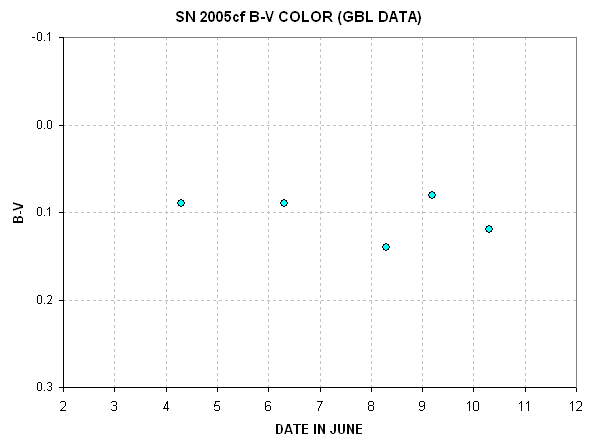
B-V color versus date.
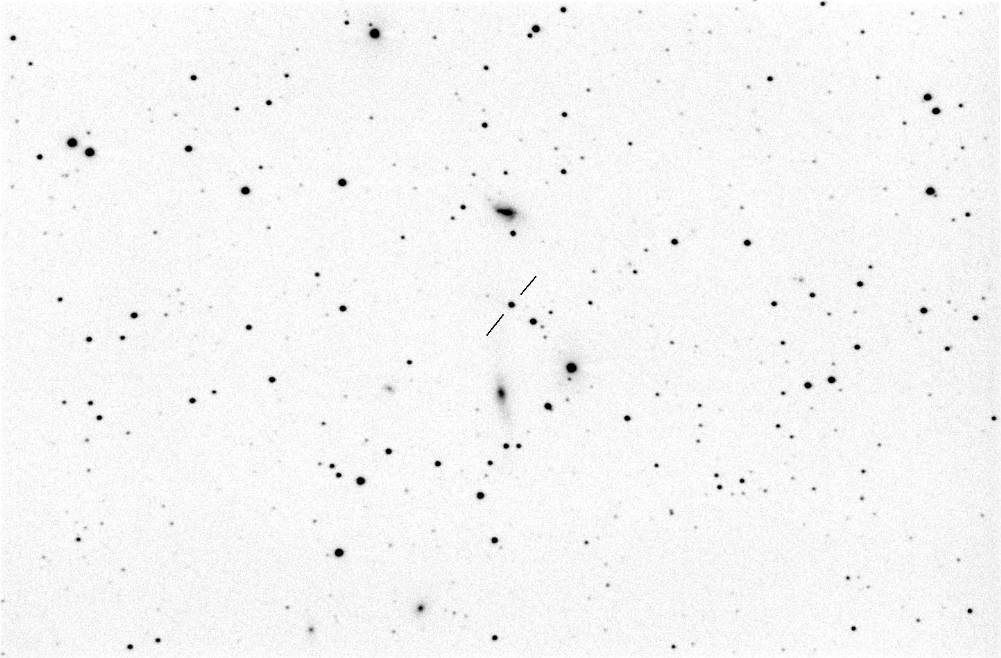
Image showing SN05cf within a star field with FOV = 23.3 x 15.3
'arc, north up, east left. Limiting magnitude is 20.2. Unfiltered,
total exposure 6.5 minutes. [Celestron CGE-1400, 14-inch SCT, focal
reducer, AO-7 image stabilizer, SBIG ST-8XE CCD; 2005.06.04 UT]
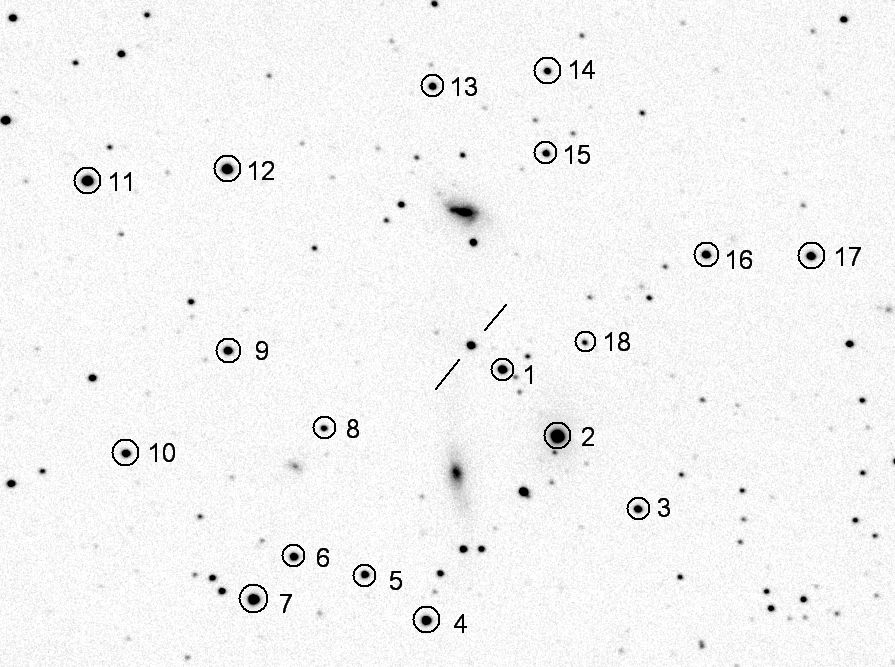
Cropped version of previous image showing reference star numbers
whose BVRI magnitudes are listed in the table, below.
Photometric Sequence
The following table currently has tentative
magnitudes for some of the 18 reference stars. It is based on two
observing nights (5604 and 5606). Considering the V-magnitudes the two
nights yield the same average magnitude for all stars. The largest
difference is 0.13 mag (Star #17). The two-night magnitude
difference is less than the stochastic SE for 14 of the 18 stars, which
is close to the 68% expected that would exist if all stars were
constant. The "Notes" column shows which stars were the same within an
SE range for the two nights. These stars can probably be counted on as
reliable, non-variable reference stars. The brightest 6 stars have been
constant during the 5 dates for which I have V-band measurements. The
mean difference in all-sky
determined V-magnitude for the stars noted as "Const" is 0.025
magnitude, which is consistent with the SE error for each night being
0.018 magnitude (and an "average magnitude" SE of 0.013 magnitude).
| Star # |
BLU |
VIS |
RED |
INF |
Notes |
| 1 |
14.96 |
14.02 |
13.53 |
13.20 |
Const |
| 2 |
10.73 |
9.97 |
9.60 |
9.27 |
Const |
| 3 |
14.88 |
14.27 |
13.67 |
Const | |
| 4 |
14.10 |
13.57 |
13.30 |
12.97 |
Const |
| 5 |
15.19 |
14.81 |
14.45 |
14.17 |
Const |
| 6 |
14.68 |
14.14 |
13.51 |
Const | |
| 7 |
13.67 |
12.75 |
12.34 |
11.99 |
Const |
| 8 |
15.55 |
15.35 |
15.10 |
||
| 9 |
15.48 |
14.32 |
13.85 |
13.45 |
Const |
| 10 |
15.51 |
14.46 |
14.06 |
13.78 |
|
| 11 |
13.61 |
12.68 |
12.25 |
11.90 |
Const |
| 12 |
13.97 |
12.88 |
12.38 |
11.95 |
Const |
| 13 |
15.09 |
14.55 |
14.15 |
Const |
|
| 14 |
15.47 |
14.83 |
14.25 |
||
| 15 |
15.29 |
14.89 |
14.50 |
||
| 16 |
14.52 |
13.89 |
13.29 |
||
| 17 | 15.45 |
14.22 |
13.67 |
13.28 |
|
| 18 |
16.00 |
14.93 |
Notice: Due to the death of a longtime colleague I am hereby
(2005.06.10) suspending my amateur astronomy
hobby for a few weeks. This addictive hobby had become the main theme
of my life recently, and I'm currently re-establishing a better balance.
____________________________________________________________________
This site opened: June 04, 2005. Last Update: June 26, 2005