GAMMA RAY BURST 050922C
Bruce L. Gary; 2005.09.23
Introduction
GRB050922C was detected by the Swift spacecraft on 2005.09.22 at
19:55 UT. The Gamma ray burst was also observed by the HETE-2 and
Konus-WIND spacecraft. The Swift also observed the optical transient
(OT) with X-ray and UV telescopes. Rykoff et al
reported (GCN #4012) unfiltered observations with the Turkish National
Observatory telescope 11 minutes after the outburst indicating CR ~
16.0 +/- 0.1; they give more accurate OT coordinates. At ~1 hour after
the outburst the
Nordic Optical Telescope (2.56-meter aperture, in South America)
Jakobsson et al reported (GCN #4015) the OT as having an
R-band magnitude of ~16.5, at the more accurate position 21:09:33.083,
-8:45:30.2 (FWHM seeing ~1.8
"arc). They later obtained an afterglow spectrum showing z = 2.17 +/-
0.03 (GCN #4017). Piranomonte et al
reported (GCN #4032) low resolution spectrum observations of the OT 1.2
hours after the outburst (when the afterglow was fading from R ~ 16.7
to 17.7); a very rich spectrum yielded z = 2.198 +/- 0.001. At 2.2
hours Ofek et al reported (GCN #4018) R ~ 17.9 (assuming 14.24 for the star 37 "arc south of the OT). Douglas Durig's
team observed the OT unfiltered at ~3.1 hours after the outburst and
measured R-equivalent magnitudes of 19.1, 19.5 and 20.1, suggesting
that fading was occuring.
HAO Observations
My observations at the Hereford Arizona Observatory (HAO)
began at 6.1 hours after the outburst. Several unfiltered images (02:00
to 02:55 UT) clearly showed the OT. I then began R-filter observations
(03:05 to 04:10 UT) and the combined image at 7.8 hours after the
ouotburst (Fig. 1) shows the OT. I then observed a region 40 'arc to
the east with stars in the Skiff catalog (Fig. 2); five of these stars
had R-mags and I used them to adjust a zero-shift parameter in my
telescope system's all-sky magnitude equation relating R-band star flux
to R-magnitude. I then resumed observing the GRB with a R-band filter
until 07:20 UT, 11.6 hours after the outburst. I quit when degraded
seeing and lower elevation angle made observing useless.
R-Band Observations
Here's an image from the first R-band observing session.
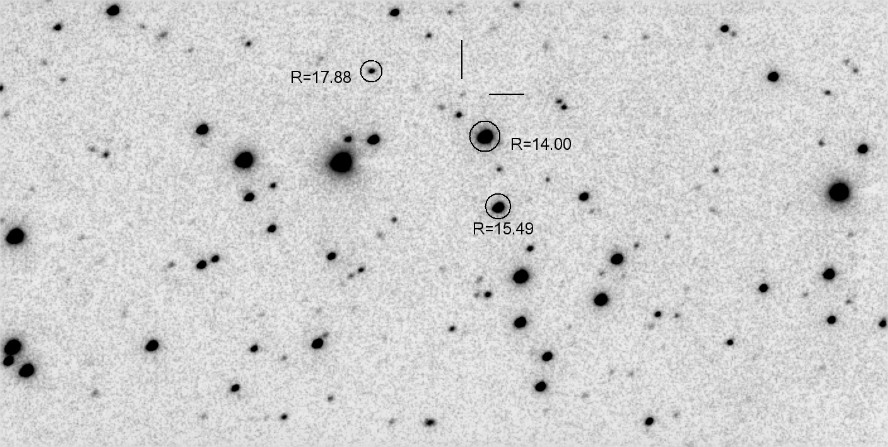
Figure 1. R-band image taken at 7.8 hours after the outburst
(2005.09.23, 03:40 UT), showing the OT (line intersection) and three
nearby stars with R-band magnitudes. FOV = 11.5 x 5.7 'arc, (crop of
much larger image) north up, east left. Limiting R-magnitude is 21.0 (SNR = 3). [Celestron CGE-1400, 14-inch
SCT, 2x focal reducer, SBIG ST-8XE CCD; Hereford, AZ]
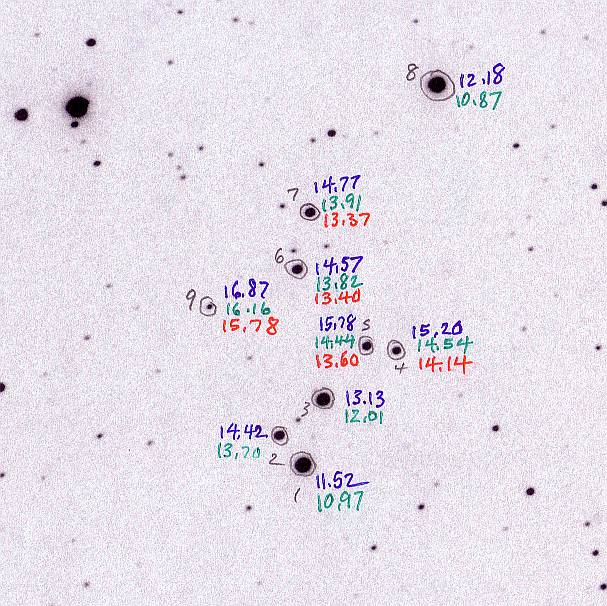
Figure 2. Brian Skiff's photometric sequence 40 'arc east of
the GRB location. The color-coded magnitude labels are for B, V and R
bands. The FOV is 9.8 x 9.5 'arc, north up, east left. The center
coordinates are 21:12:11, -08:50.
The Skiff catalog stars were used to adjust a zero-shift constant
in an all-sky magnitude equation for my system for this night's
observations. Previous
all-sky measurements of Landolt areas have led to the following
equation for
relating star magnitude and color to observed star flux for my
telescope system in a Cassegrain configuration:
R-mag = 19.74 - 2.5 * LOG ( S / g ) - 0.13 * m - 0.11 * C,
where S = star flux with a large
photometer aperture (S = S' / f, where S' = flux with a small aperture
and f = recovery fraction of small aperture compared to large aperture),
g = exposure time [seconds],
m = air mass,
C = star color, defined as either 0.57
* (B-V) - 0.31 or V-R - 0.30 (usually equivalent); C = 0 for a typical
star.
The first term, 19.740, is the zero-shift constant, and it actually
remains constant for months at a time. On this night the Skiff stars
called for a slight adjustment, to 19.725 +/- 0.025. The SE of 0.025 is
based on the RMS scatter of the differences between Skiff's R-mag
values and my equation star magnitudes (using the above equation and
zero-shift adjustment). The star color coefficient, -0.11, appeared to
be supported by the 5 Skiff stars, which is a quick check I always
perform.
Using this "simplified magnitude equation" it was possible to convert
the OT's flux (S' = 86 +/- 10 counts, f = 0.95), and an assumed C = 0, to R-mag =
19.86 +/- 0.12. The previous SE is the stochastic component, based on
SNR = 8.5. I estimate the systematic SE to be ~0.05, which is much less
than the stochastic component. Extinction doesn't produce any
uncertainty because the OT and Skiff stars were at the same air mass
(observed minutes apart). The OT's color is another source of
uncertainty. If C = +0.5, for example (corresponding to V-R = +0.8),
then R-mag would be 19.80. Thus, there's a component of systematic
uncertainty estimated to be +/-0.06 mag due to our not knowing the OT's
color. Adding the three SE components yields:
R-mag = 19.86 +/- 0.14.
After a meridian flip and dark frame sequence (and dinner) I resumed
R-band observations of the GRB. However, seeing was degrading rapidly
so these post-transit observations are of lower quality than the
pre-transit ones.

Unfiltered Observations
Here is an unfiltered image showing the OT at about CV = 19.1 at 02:30 UT.
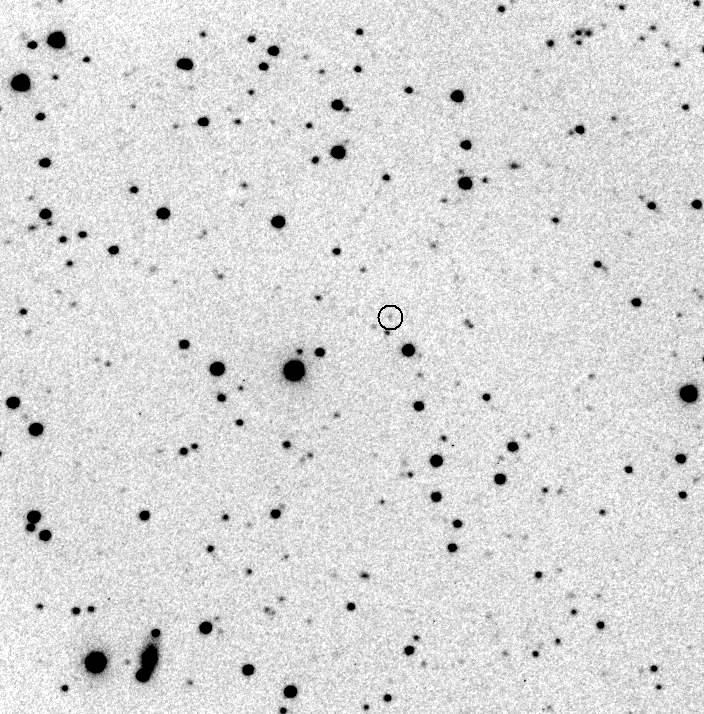
Figure 3. Unfiltered image of the OT at 6.8 hours after the outburst.
I converted unfiltered OT fluxes to CV magnitudes using the following equation:
CV-mag = 21.35 - 2.5 * LOG ( S / g ) - 0.14 * m + 0.54 * C
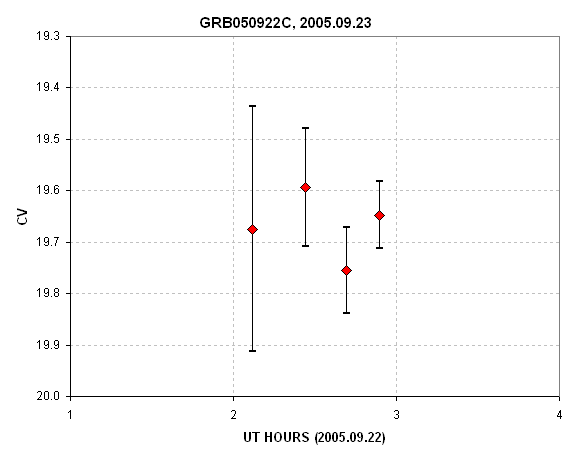
Figure 4. Unfiltered measurements of GRB050922C during a
1-hour observing session. Stochastic SE error bars are shown. These CV
magnitudes assume that the GRB color is similar to that of a typical
star.
There is no apparent fading during this one-hour observing interval,
but this is unsurprising due to the large stochastic uncertainties of
each measurement.
Miscellaneous
Hardware
"Hereford Arizona Observatory" (G95)
AstroPhotos
Pretty pictures
(plus links to many other pages)
Professional and
Personal (everything branches off from this page)
__________________________________________________________
First created: 2005.09.23 Last updated: 2005.09.23