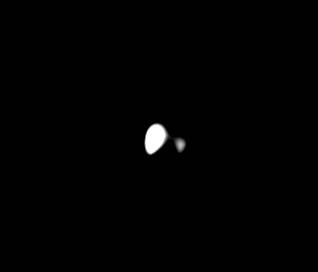
There's a star system in which the two brightest orbit each other in
60 years. When I learned this I wanted to record images showing their
orbital motion. I guess I'm still amazed by the fact that stars are not
fixed, as I had believed when I was a boy. In fact, few adults today
realize that stars move. When I began the Alula Australis project in
2002 I realized that I probably
wouldn't live long enough to be able to show the motion (since I come
from
a short-lived family and I was 63 years old when I took my first
image).
Nevertheless, I now have images from a 2-year span so I'm going to
begin
presenting results of the project.
Alula Australis is located in Ursa Major, at RA = 11:18:11, Dec =
31:31:45
(epoch 2000).
2002 May 24
Figure 1. 2002 May 24 "median combine" of six 0.1-second
images.
Substantial image enhancement has been performed in order to emphasize
the
location of the brightest part of the fainter star. FOV = 18 x 16 "arc
and
north is up, east is left. [Meade LX-200 10-inch SCT with 5-inch
aperture
mask; SBIG ST-8E CCD; Santa Barbara, CA]
The image scale and orientation were adjusted to a standard value of
9.04
"arc/pixel and north up, east left (which corresponds to what is
achieved
by a properly oriented Celestron CGE-1400 at prime focus after a 8x
enlargement).
For these observations the telescope must have been "out of
collimation"
since all images exhibited a non-circular point-spread-function (PSF)
for
all stars, with FWHM = 2.69 "arc in the north-south direction and FWHM
=
1.52 "arc in the east west direction (before image enhancement).
The separation of the stars in this average image is 1.69 +/- 0.14 "arc, and the position angle of the fainter star is 104.0 +/- 3.3 degrees. (Position angle is defined using a line with one end fixed to the brighter star and rotated clockwise from north until the line intersects the fainter star).
2004 June 4
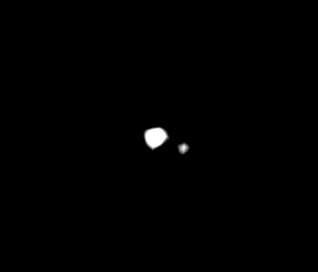
Figure 2. 2004 June 4 average of four 0.3-second
images. Substantial
image enhancement has been used to emphasize the brightest part of the
fainter
star. FOV = 18 x 16 "arc, north up, east left. [Celestron CGE-1400,
Cassegrain,
SBIG ST-8XE CCD; Hereford, AZ]
This image has the same "image scale" (0.05856 "arc/pixel after 8x
enlargement)
as the previous image. The PSF has FWHM of 1.8 "arc in all azimuthal
directions
in the original, unenhanced image.
The star separation is 1.76 +/- 0.08 "arc and the fainter star is at
a position nangle of 111.4 +/- 1.8 degrees.
Comparing the two images the fainter star has moved with respect to
the
brighter star a distance of 0.23 +/- 0.09 "arc during a 2-year
interval.
Another way of describing the motion of the fainter star during the
2-year
interval is that the separation changed 4 +/- 9 % (not statistically
significant)
and the position angle changed by 7.4 +/- 3.8 degrees (marginally
significcant,
statistically). Additional yearly observations will be needed to
establish
that the movement is statistically significant. "Stay tuned" (assuming
I
live long enough for this project).
2005.05.20
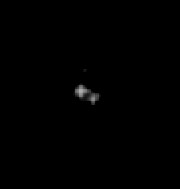
2005 May 20, with JBO 32-inch.
SUMMARY OF MOTION
Graph of Orbit
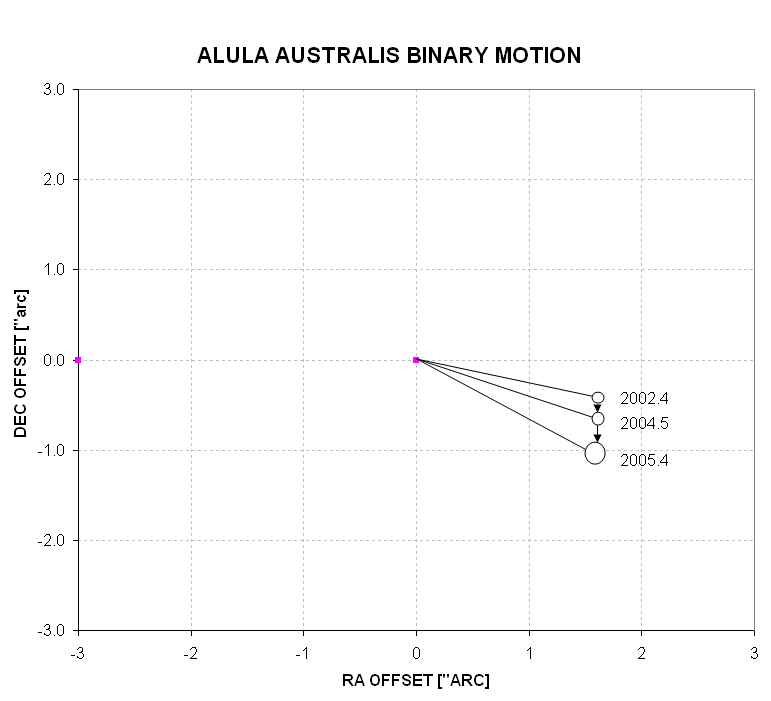
Plot of position of secondary with respect to primary for 3
dates.
Animation
Combining the 2002 May 24 image with the 2004 Jun 04 image to
produce an animation yields the following:
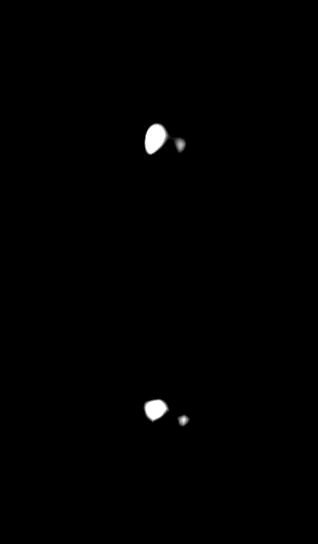
Animation of images from 2002.05.24 and 2004.06.04. FOV =
18 x 16 "arc.
The fainter star appears to have moved south during the 2-year interval.
____________________________________________________________________
This site opened: June 6, 2004. Last Update: May 20, 2005